The Second Image Re-Analyzed: The Attitudinal Effects of Democracy on Conflict and Cooperation Yehzee Ryoo, Jonathan Renshon, Joshua D. Kertzer and Alex Coppock.
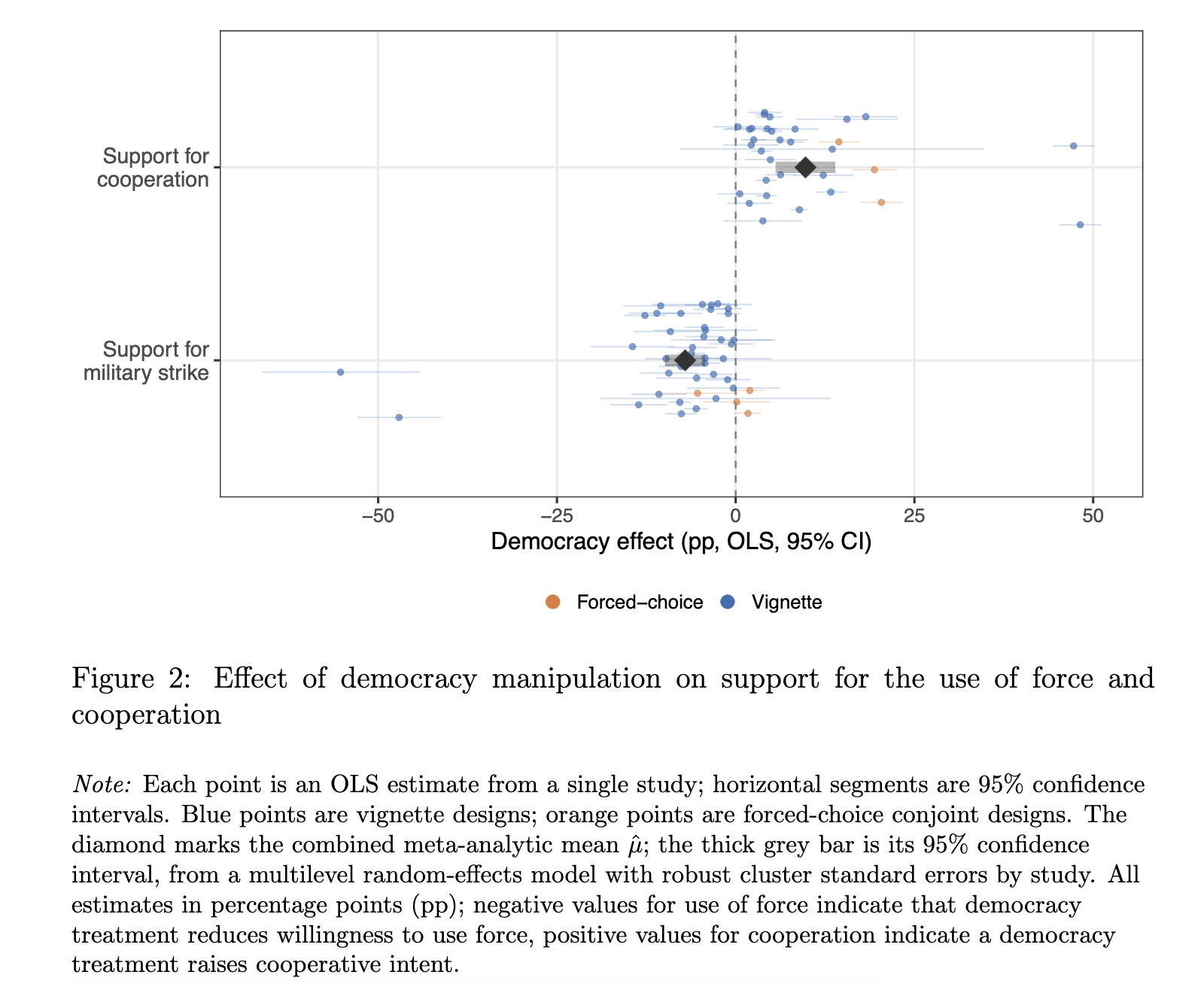
While questions of war and peace have always been central in IR, a large body of literature in recent years has focused on “second image” explanations: the impact of regime type on preferences for war, trade and cooperation. Since many explanations carry implications for the individual level, IR scholars have fielded a large number of experiments designed to assess the impact of regime type treatments on preferences and beliefs about conflict and cooperation. We re-analyze all existing regime type experiments related to these topics (N = 184 estimates from 137 studies in 46 papers) and find consistent effects on preferences for war (lower for democracies) and cooperation (higher for democracies). Within these main results, we also find notable variation, and use our meta-analysis to assess explanations that bear on both the direction of the results and variation within them. We present results suggesting that the direction of the main effects of democracy on policy preferences can be plausibly explained by the consistent effects of regime type on a large number of potential “belief-based” mediators. Finally, we find that the significant variation within the results can be explained by a combination of temporal patterns—changing beliefs about democracy—as well where a study was fielded and aspects of study design (notably, the level of detail provided in experiments and the structure of the experimental design).