Negativity Bias and the Elasticity of International Reputations Ryan Powers & Jonathan Renshon.
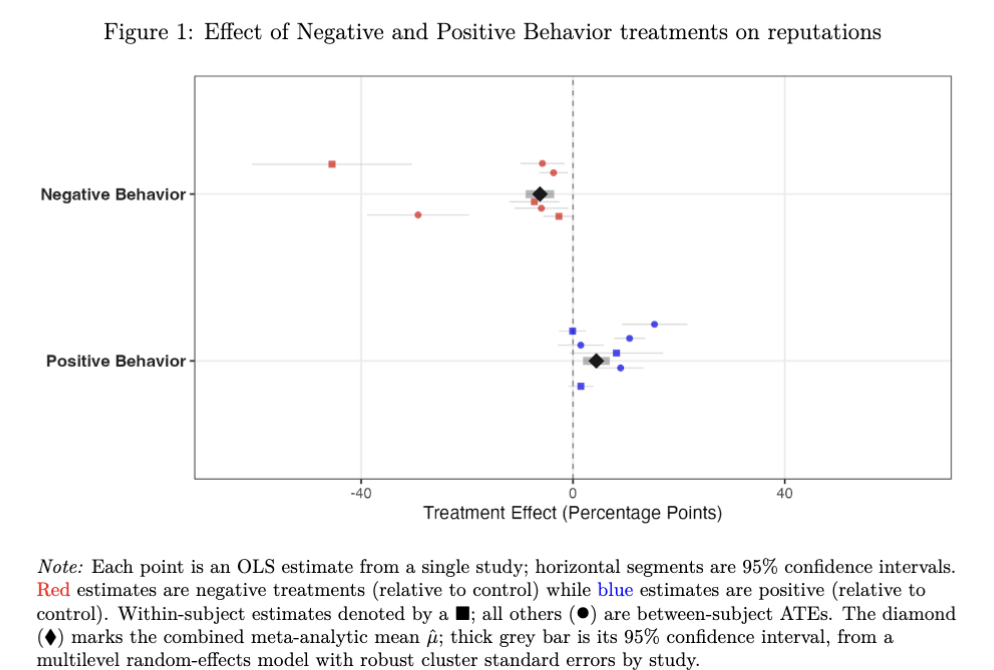
In the aftermath of foreign policy misadventures or domestic crises, it is common for observers to ask, can [insert country]'s reputation be repaired? As important a question as this is, scholarship on reputations in IR is not well-suited to answering it, as we demonstrate with a systematic review of past survey experiments on reputation in IR. We conceptualize this question as bearing on the elasticity, or sensitivity, of reputations to past behavior. Our broad argument is that reputations are subject to negativity bias: the tendency to privilege negative information over positive. More specifically, we argue that reputations are more easily damaged than repaired and that bad behavior is worse for states' good reputations than good behavior is beneficial for bad ones. To demonstrate this, we first meta-reanalyze existing experiments (n=5, k=7, total N=7,853) that are structured in such a way as to allow us to identify negativity bias in perceptions in IR. We find that negative behavior effects on reputations are approximately 41% larger in absolute terms than positive behavior effects as well as tentative evidence that reputations are easier to ruin than to repair. Second, we describe the results of an original pre-registered experiment that tests our argument.